CONTACTS: +254 726879488 (Mobile)
+254770 455 116 (Office)


The government of Kenya, through the Ministry of Water, Sanitation and Irrigation (MWSI), on Monday made a rallying call to the private sector players and financiers to fund 61 percent of its ambitious National Irrigation Sector Investment Plan (NISIP) 2025-2035 valued at USD 4.6 billion or KES 598 billion in the next 9 years.
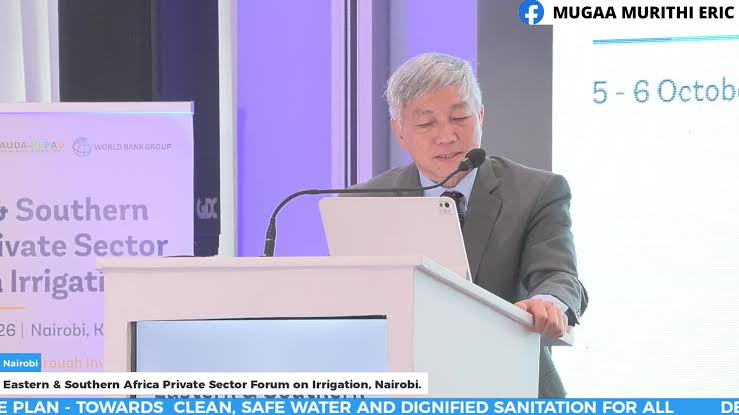
Speaking today during the Eastern and Southern Africa Private Sector Forum on Irrigation in Nairobi, the MWSI Cabinet Secretary, Eng. Eric Muriithi confirmed that “Kenya was open for business on matters of irrigation,’ as it seeks to fulfill its NISIP 2025–2035 10-year strategic roadmap meant to expand over 1.5million acres of the country’s available land for irrigation to bolster food security and climate resilience.
“Public financing alone cannot get us there, and it was not designed to. The NISIP is an instrument for rallying the whole sector, government, donors, commercial banks, equipment suppliers, agribusinesses, around one architecture, one accountability framework, and one set of outcomes,” said Muriithi.
Adding that, the ministry “had made it the central commitment in our Agriconnect and Water Forward compacts, and we are asking our development partners to align behind it. And we are asking the private sector to find their chapter within it.”
The forum, which attracted 39 governments and various private sector players, had been put together to identify the key barriers, risks and market failures limiting private investment in the irrigation sector, informed by the experience and needs of different private-sector segments.
The World Bank and IFC are lead partners tasked to actualise the NISIP through K-RISE — Kenya’s Resilient Irrigation for a Sustainable Economy program, whose development is nearing completion according to the CS, with the two–day forum which ends tomorrow forming part of presenting that architecture to the market.
“We are offering financial instrument solutions to help address some of the hurdles in the irrigation sector…we are here to begin a sustained outcome of job creation and farmer empowerment,” said Qimiao Fan, the Division Director, Eastern and Southern Africa Region for the World Bank.
K-RISE has built around three financial instruments, including the Results-Based Finance Facility, which is expected to provide rebates and grants to irrigation equipment dealers, suppliers, and service providers against verified sales and installations — particularly for energy-efficient systems reaching smallholders.
This means that, if an investor sells and installs qualifying systems and reaches its target farmers, the ministry and its partners pay on outcomes. “You expand your market; we get verified coverage,” said Muriithi.
Similarly, the ministry will leverage its targets on the Risk Sharing Facility model to de-risk lending. It provides first-loss and partial credit guarantees to commercial banks, MFIs, and SACCOs that develop irrigation-specific loan products, and the Patient Capital Facility hoped to address the longer repayment horizons that irrigation equipment suppliers and last-mile financiers need.
Indeed, the government has identified 10 irrigation schemes for a pilot programme aimed at increasing agricultural production and opening up new markets for farmers.
The schemes cover about 14,819 acres and have a combined 52,115 farmers, with crops ranging from rice, maize and horticultural produce to vegetables, pulses, potatoes, onions and avocado.
The government also wants farmers to strengthen aggregation through cooperatives while establishing direct links with processors, exporters and other buyers.
You cannot copy content of this page